Nothing In Life Is Instantaneous
Building & Releasing Five Percents
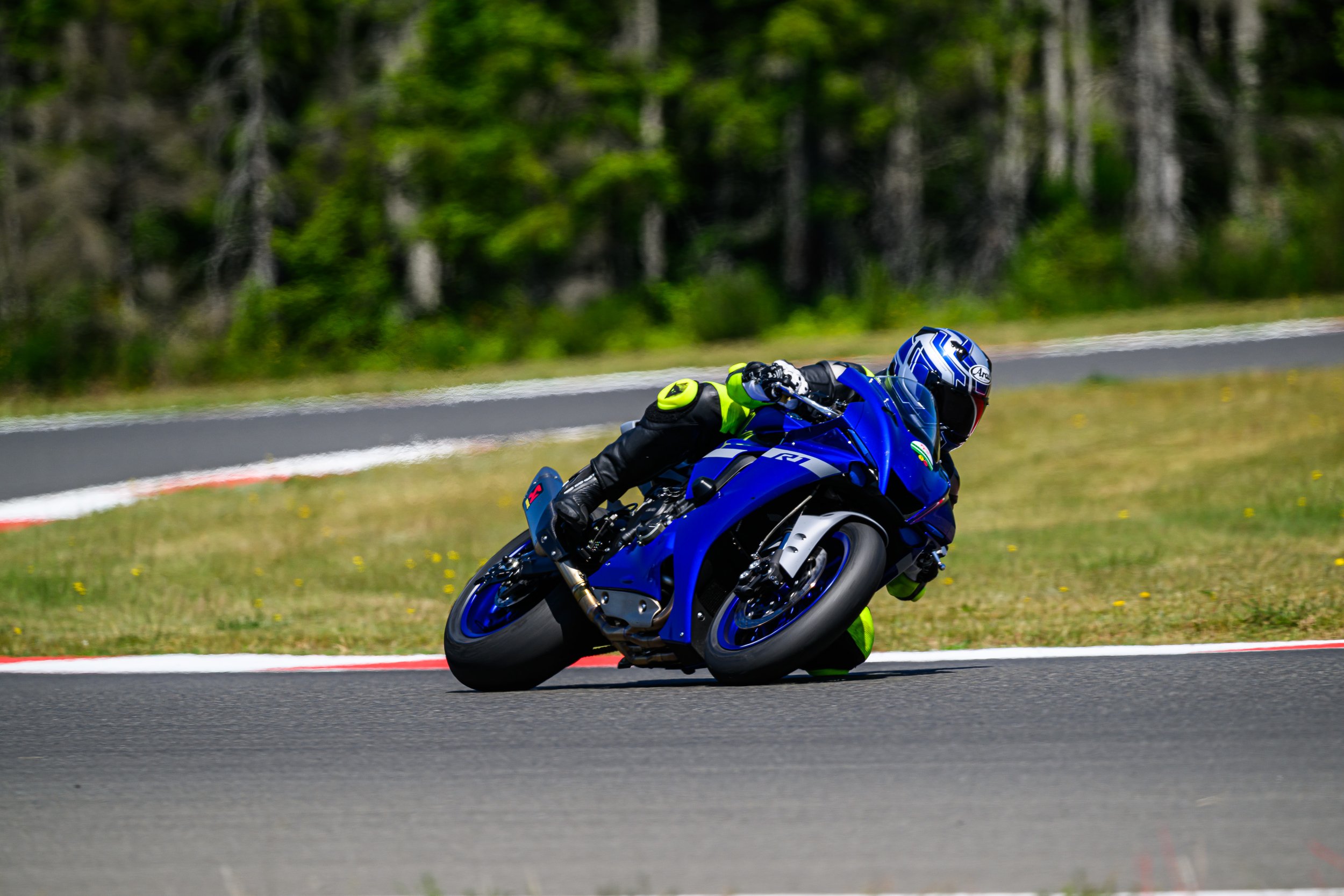
Photo by G. Powers Photography
I was questioning why we have the word, instantaneous. Because if nothing in life is instantaneous, then why do we even have a word for such a thing. It hit me when I was looking up the speed of light, the fastest thing we know. 186,000 miles per second in a vacuum. By vacuum they must mean outer space. Also, the ratio was in miles per second, not miles per hour! Have you read reducing the denominator? I’m willing to bet that the word, instantaneous, came before we could record the speed of light. Because of our sloth-like speed in the mornings, some things seem instantaneous. Like that alarm clock. Other examples include flashlights and electricity.
You may be thinking, “Come on Scott. How does this relate to motorcycles, driving or mechanic stuff?” Abrupt is a word similar to instantaneous. And abrupt was a word used to describe my track riding by a recent instructor. In my defense, I was riding a bike that I don’t ride as much, the ZX6RR. But as I did get accustomed to it, he, Tino, still had a point. Plus, my buddy from northern California has said to me before, “It seems like you are dropping anchor going into the chicane.” Slang for: You are abrupt when going to the brakes for the chicane. As your pace comes up, your allowance for abruptness goes down.
Ken Hill’s Five Reasons Why WE Crash:
Loss or Lack of Focus (no plan)
Abrupt Inputs (no 5%’s)
Rushing Direction
Repeating a Mistake
Overconfidence (emotion)
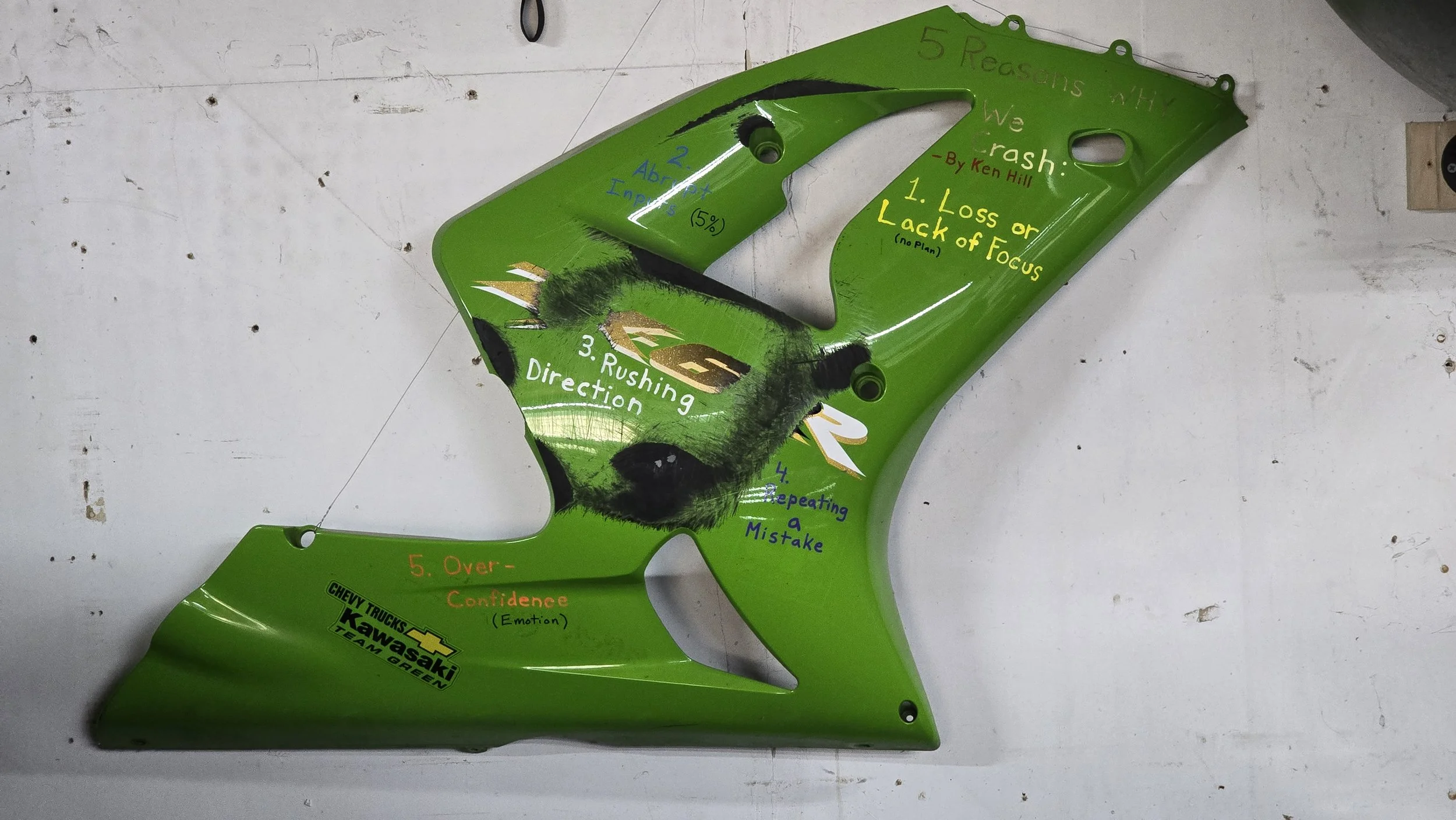
I used this crashed fairing in 2018 to list Ken Hill’s, “Five Reasons Why We Crash” while recovering from knee surgery. I had crashed on my KLX140 in my backyard. Not a scratch on the bike. Me, torn ACL. LOL! This crashed fairing was from July 9th, 2014, turn 12 at The Ridge. The cause of the crash? I was focusing on doing 2 through 5, unknowingly.
This is something we all can work on. Some people just need some refining, some people need a lot of work. Parking lots are the breeders of abruptness if we don’t pay attention to it. Why? Because in parking lots we are going too slow and our tires have too much grip. Once those parking lots become filled with snow, our abruptness comes to light quickly. This is why some people won’t drive in the snow.
Ken Hill and Yamaha Champions Riding School (YCRS) both teach five percent. They are talking about your first five percent and your last five percent of our motor controls applied to the vehicle. Brakes, throttle, steering. For example, when you go to apply the brakes, there should be no stabbing the brakes; even in an emergency. You can stop faster than your Automatic Braking System (ABS), if you practice.
You can’t stab, or grab 40% brake pressure without going through all the integers leading up to 40%. There is no 0%, then 40%. There is no 2, if you don’t have 1. There is no 3, if you don’t have 2. No matter how fast you get to 40%, you still have to go through 1%, 2%, 3%, 4%, 5%, 6%, 7%, 8%… You get the point. The problem with abruptness or appearing like instantaneous is, the speed at which you apply the vehicle’s controls is faster than your tire’s ability to respond. This is where Ken Hill and YCRS come in, they teach you to be aware of your initial and releases of the vehicles’ controls. I have felt the front tire slide at turn 2 of The Ridge because of my abrupt release of the brake lever. It’s not just the initiation of the controls that’s important, it’s also the release to the control.
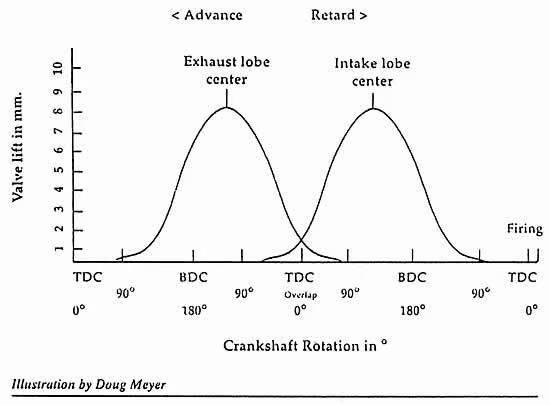
I think an excellent example of this is a camshaft lift graph. The camshaft slowly builds pressure on the valve, so there is control, then quickly opens it to maximum valve lift, then quickly closes the valve. But wait! Before the camshaft actually lets go of the valve, it slowly brings that valve down for a soft kiss to its valve seat, trying to eliminate the action of valve bounce (valve float). What Ken and YCRS are saying is, you can be forceful with your inputs, just as long as you respect the one-two-three-four-five percents and the five-four-three-two-one percents. A famous YCRS saying is: Load the tire, before you work the tire. And for me at turn 2, be careful how you unload the tire. The radius of the corner affects how fast you apply and release your five percents. It doesn’t make any sense to quickly apply your 5% to a long sweeping corner and vice versa. Remember corner radiuses and matching your controls are explained in, “What I’m Working On” newsletter?
It helps to say it aloud or in your head as you apply and release your five percents. (Note, saying aloud is good for building that technique into a habit, because it brings focus to what you are working on. Once the technique is a habit, work on the technique without saying it aloud or in your head. Because you want to be a “feeler” not a “thinker”.)
If, “how we do anything is how we do everything”, then, these five percents should be practiced on everything we do. Keyboard strokes may be for the elites, but maybe we could start with the way we pour some milk. Or maybe the way we pickup and set down your expensive phones. Maybe the way we sit or get out of a chair.
According to Cody Wyman, a lead instructor at YCRS, there is one exception to abruptness. It’s taking away lean angle, or reducing your lean angle. Ken Hill says, always be in a position to catch a slide. This would be a position to abruptly reduce lean angle.
